
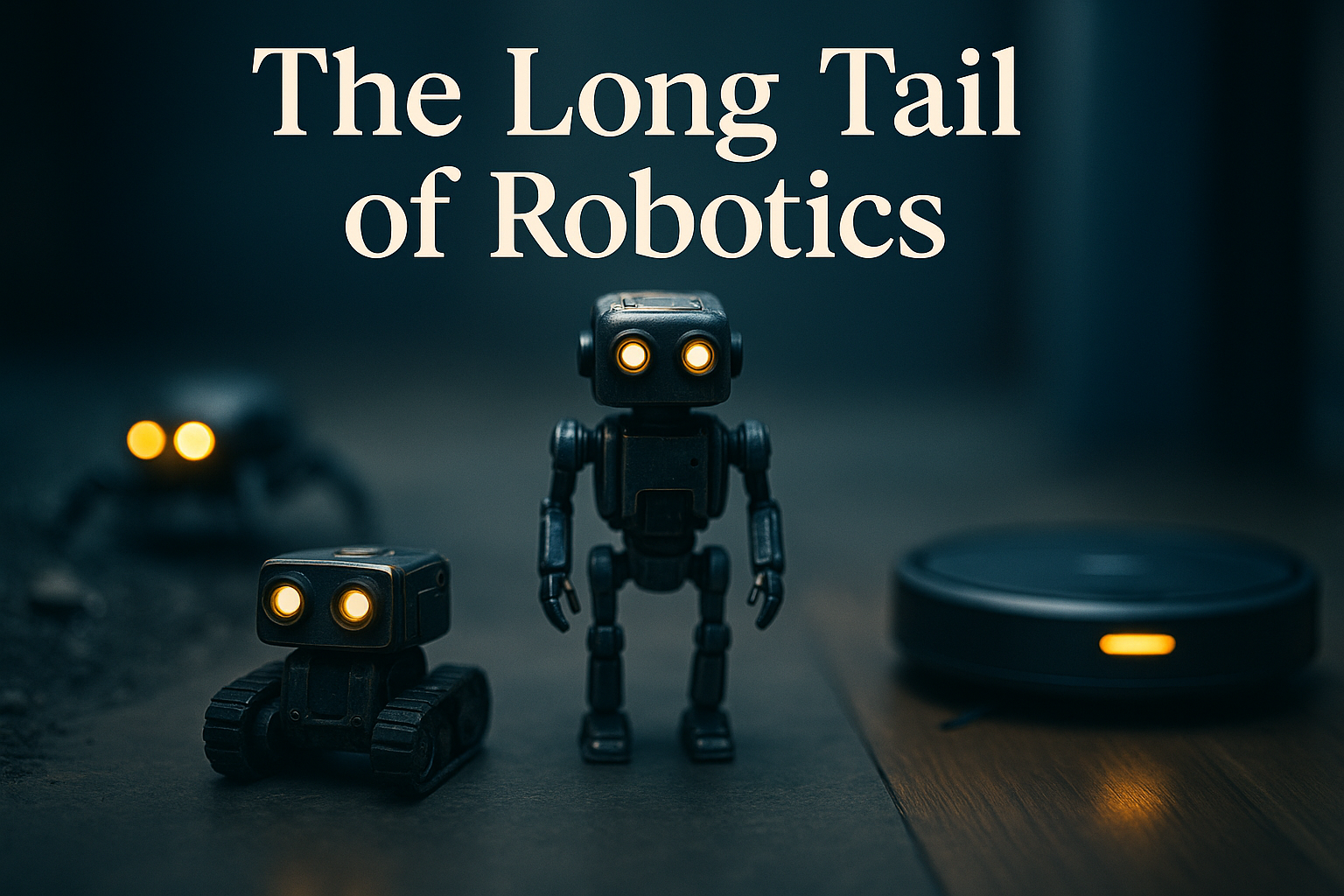
The robotics story most people follow is the big one. Humanoid robots. Autonomous vehicles. Warehouse automation at Amazon scale. These are the headlines, and they are real, but they are also the hardest market to enter, the most capital-intensive to compete in, and the most covered by every analyst, investor, and journalist with a technology beat.
The more interesting story is what is happening in the long tail. The niches that do not make headlines. The applications that are too specific for a general-purpose robot but too valuable to ignore. The markets that the big players will not bother with because they are not big enough to matter to a company worth tens of billions of dollars, but are more than large enough to build a serious business around.
This is where the next wave of robotics value is being created. Not in the flagship products, but in the thousand specific applications that nobody is talking about yet.
Why the Long Tail Is Opening Now
For most of robotics history, the economics only worked at scale. A custom robot arm for an automotive assembly line costs millions to develop, integrate, and maintain. That cost is justified when you are running the same motion ten million times. It is not justified when you are a mid-sized food processor running three shifts a week on a product that changes seasonally.
Two things have changed. First, the cost of sensors, actuators, and compute has dropped by roughly 80 percent in the last five years. A robot that cost $200,000 to build in 2019 costs $40,000 to build today. Second, the software layer has matured. Computer vision that required a team of specialized engineers to implement five years ago can now be configured by an integrator in weeks using off-the-shelf models.
These two shifts together mean that applications which were economically unviable are now worth building. The addressable market for robotics has expanded dramatically, not because the big markets got bigger, but because hundreds of previously unaddressable small markets became reachable at once.
Where the Opportunities Are
Agriculture is the most obvious example. Row crop farming at scale has been automated for decades. What has not been automated is the specialty produce segment, the work that requires hands capable of knowing when a strawberry is ready to pick without bruising it, or identifying which heads of lettuce have bolt damage. These tasks have resisted automation because the precision requirements were too high for the economics to work. That is changing. Several companies are now operating commercial systems in this space, and the market for specialty crop harvest robotics alone is projected to reach $8 billion by 2028.
Healthcare is a less obvious one. The clinical environment is resistant to automation for regulatory and liability reasons, but the back-of-house operations are not. Medication dispensing, specimen transport, linen management, environmental cleaning. These are repetitive, high-reliability tasks in a controlled environment where robots perform well. The resistance to automation here is cultural more than technical, and it is softening as hospital systems face staffing shortages with no near-term resolution.
Hospitality and food service is the third area worth watching. Not robots replacing servers, but robots handling the specific tasks where consistency and reliability matter more than human judgment. Dishwashing. Prep work. Inventory checking. The applications that have high turnover, high error rates, and low variability. These are not glamorous. They are also not optional for operators trying to hold margins as labor costs rise.
The Strategic Implication
For investors, the long tail of robotics means the opportunity set is much larger than the headline applications suggest. The companies building niche solutions for specific verticals are not consolation prizes. They are the actual opportunity for anyone who cannot write a check large enough to compete with the humanoid robot companies.
For operators and strategists, it means the question to ask is not "how do we automate everything?" It is "what specific, repetitive, high-reliability tasks are we doing at sufficient volume that a focused robotics solution would pay for itself in under 18 months?" That question, asked honestly, has an answer in almost every operation of meaningful scale.
The big robotics companies will win the big markets. The long tail belongs to everyone else. And in aggregate, the long tail is larger.
Want a deep dive on robotics opportunities in your specific sector? Get a full Arlo Report delivered to your inbox in under 10 minutes, starting at $15. Order at arlobottman.com/research