
Executive Summary
- Edge compute, perception stacks, and model operations (MLOps) are the three foundational technologies determining which organizations extract measurable value from AI investments in 2026.
- Edge compute reduces latency and data transmission costs by processing intelligence closer to the point of action; deployments in manufacturing and logistics show 30 to 60 percent reduction in operational latency.
- Perception stacks, combining computer vision, sensor fusion, and real-time inference, are the critical enabler for physical AI applications; the market is projected to reach $34 billion by 2028.
- Model operations infrastructure determines whether AI models perform in production or degrade silently; organizations without MLOps capabilities are experiencing model accuracy drift of 15 to 40 percent within 12 months of deployment.
- Strategic leaders should evaluate vendor relationships and internal capabilities against all three technology layers before committing to AI-dependent business strategies.
Background and Context
The dominant narrative around AI strategy in 2025 and 2026 has focused almost exclusively on foundation models: which large language model is leading, which provider has the best price-performance ratio, which organization has the most parameters. This framing is understandable but strategically incomplete.
Foundation models are inputs. The organizations that build durable competitive advantage from AI are not the ones that selected the best model. They are the ones that built the infrastructure to deploy models reliably, operate them at scale, and integrate them with physical and data systems close to the point of value creation.
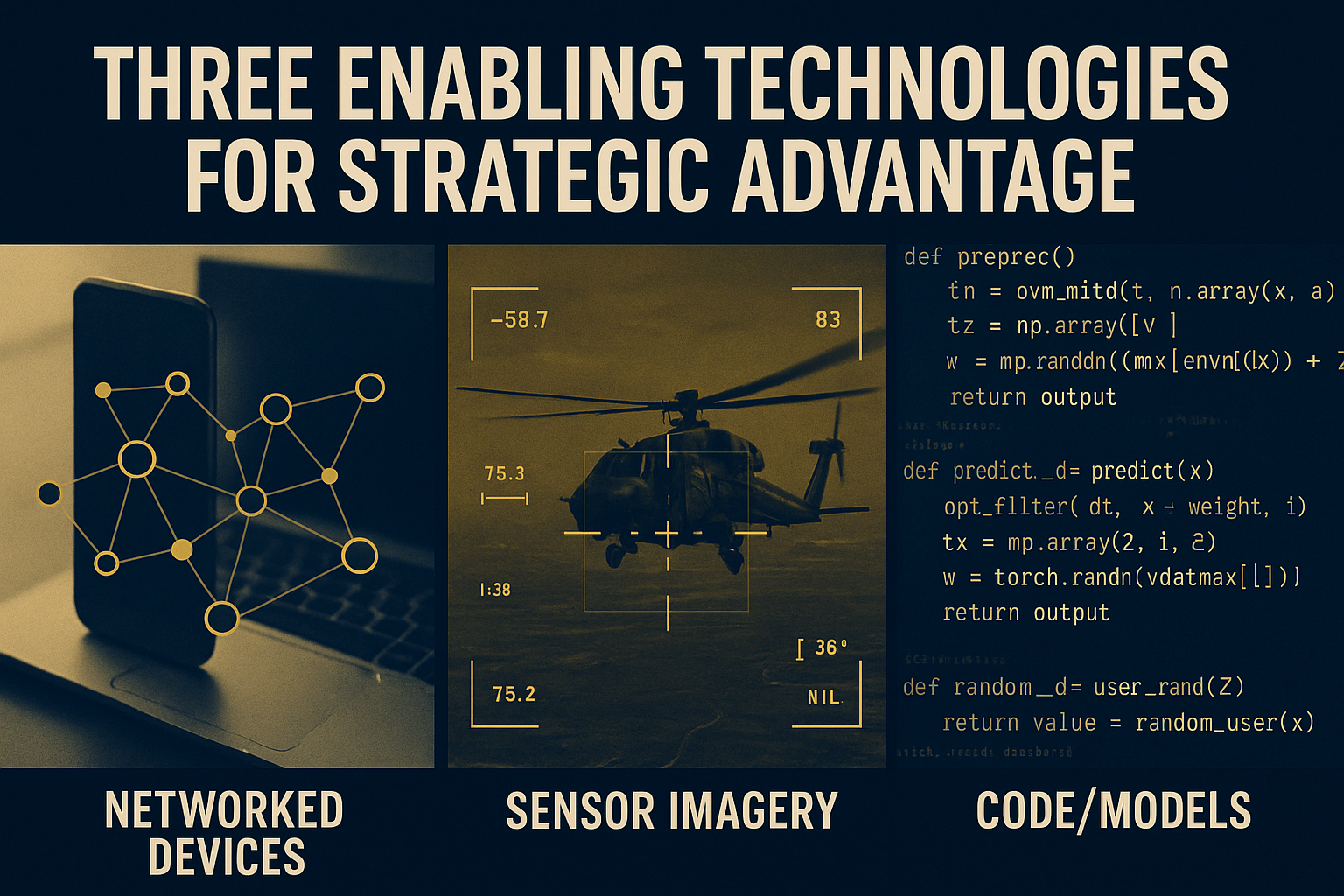
Three enabling technologies determine whether that infrastructure exists. Edge compute, perception stacks, and model operations are not glamorous. They do not generate the same conference coverage as GPT-5 or the latest reasoning benchmark. They are, however, the difference between an organization that demonstrates AI in a pilot and one that captures AI-driven value at scale.
Key Finding One: Edge Compute
What It Is
Edge compute refers to the processing of data and inference at or near the source of data generation, rather than transmitting that data to a centralized cloud for processing. In practice, this means deploying compute hardware in factories, vehicles, retail locations, medical facilities, and any environment where latency, bandwidth costs, or data sovereignty requirements make cloud-dependent processing impractical.
Current Deployment Landscape
The edge compute market reached $61 billion in 2025, with industrial applications accounting for 34 percent of deployments. The fastest-growing segments are manufacturing quality control, autonomous logistics, and real-time infrastructure monitoring. Major hardware providers including NVIDIA, Intel, and Qualcomm have all released edge-optimized silicon specifically designed for inference workloads in the past 18 months.
Strategic Implications
Organizations dependent on cloud-only AI architectures face three compounding vulnerabilities: latency constraints that limit real-time decision-making, data transmission costs that scale linearly with data volume, and single points of failure when connectivity is disrupted. Edge compute addresses all three.
The organizations most exposed to these vulnerabilities are in manufacturing, logistics, healthcare, and retail, where physical processes generate high volumes of sensor data and require low-latency responses. Strategic leaders in these sectors should evaluate their current architecture against edge compute alternatives, particularly for applications where sub-100-millisecond response times are operationally significant.
Key Finding Two: Perception Stacks
What They Are
Perception stacks are the integrated software and hardware systems that enable machines to sense, interpret, and respond to their physical environment. A complete perception stack combines computer vision (interpreting visual data), sensor fusion (integrating inputs from multiple sensor types including LiDAR, radar, and infrared), and real-time inference (generating actionable outputs fast enough to influence physical processes).
Market Trajectory
The global machine perception market is projected to grow from $14.2 billion in 2025 to $34.1 billion by 2028, a compound annual growth rate of 34 percent. This growth is concentrated in three application areas: autonomous vehicles and mobile robotics, industrial quality control, and smart infrastructure monitoring.
The key technical development driving this growth is the maturation of sensor fusion algorithms that can integrate heterogeneous sensor inputs with sufficient reliability for production deployment. Computer vision alone has significant limitations in variable lighting, occlusion, and environmental conditions. Multi-sensor fusion substantially improves reliability, and the cost of the required sensor hardware has declined to levels that make commercial deployment viable across a broader range of applications.
Strategic Implications
Organizations evaluating physical AI applications (robotics, autonomous inspection, real-time quality control) should evaluate vendors not only on the performance of their computer vision capabilities but on the completeness and reliability of their full perception stack. A system that performs well in demo conditions but degrades under production environmental variability is not commercially viable.
The key evaluation criteria are: sensor fusion architecture (how many sensor modalities are integrated), performance across environmental conditions (lighting, weather, occlusion), inference latency (time from sensor input to actionable output), and production track record (number of deployments and documented uptime).
Key Finding Three: Model Operations (MLOps)
What It Is
Model operations, commonly referred to as MLOps, encompasses the processes, tools, and infrastructure required to deploy AI models reliably and maintain their performance over time in production environments. This includes model versioning, automated retraining pipelines, performance monitoring, drift detection, and rollback capabilities.
The Production Gap
The AI industry has a widely documented production gap: the majority of AI models that perform well in development and testing degrade significantly within 6 to 18 months of production deployment. The primary cause is data drift, the gradual divergence between the data distribution the model was trained on and the data it encounters in production as real-world conditions change.
A 2025 survey of enterprise AI deployments found that 67 percent of organizations reported measurable model accuracy degradation within 12 months of deployment, with average accuracy decline of 22 percent. Organizations with mature MLOps infrastructure reported degradation rates of 6 percent over the same period.
Strategic Implications
MLOps capability is not optional for organizations making significant AI investments. It is the difference between AI as a depreciating asset and AI as a durable capability. Organizations that deploy models without the infrastructure to monitor and maintain them are not building AI capabilities. They are making one-time purchases that will require replacement on an unpredictable schedule.
The strategic investment required is not primarily in tooling (the MLOps tooling market is mature and competitive) but in internal capability. Organizations need data scientists or ML engineers who understand production systems, not just model development. This talent gap is the primary implementation challenge for most enterprises.
Implications and Recommendations
For corporate strategy and R&D leaders: evaluate AI investments against all three enabling technology layers. A strong foundation model strategy without edge compute, perception, or MLOps infrastructure is a strategy for pilots, not for durable competitive advantage.
For venture capital and private equity: the enabling technology layer is where infrastructure value concentrates. Companies building edge compute infrastructure, perception stack components, and MLOps tooling for specific verticals have more defensible positions than application-layer companies dependent on commodity foundation models.
For product and technology leaders: MLOps investment should be treated as a prerequisite for production AI deployment, not a phase two consideration. The organizations that build this capability early will have substantially lower ongoing costs and higher reliability than those that defer it.
Sources
- IDC Edge Computing Market Forecast 2025 to 2028
- Gartner AI Infrastructure Survey 2025
- McKinsey Global Institute: The State of AI in Enterprise 2025
- NVIDIA Edge AI Deployment Report Q4 2025
- MarketsandMarkets Machine Perception Market Analysis 2025
- MIT CSAIL Production AI Performance Study 2025
- Algorithmia State of Enterprise ML Report 2025
This report was generated using the Arlo Reports research pipeline. For a customized intelligence brief on technology investments relevant to your organization, visit arlobottman.com/research.